



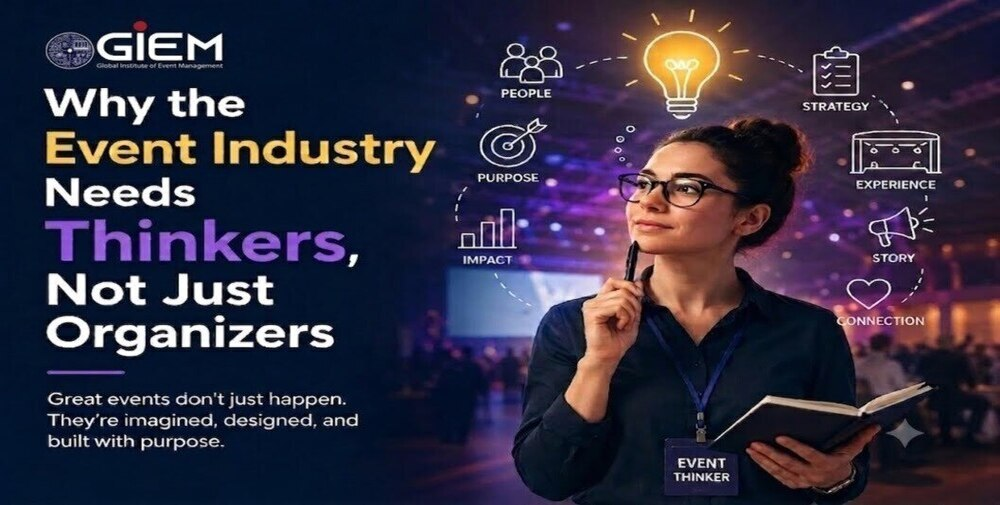
Why the Event Industry Needs Thinkers, Not Just Organizers
The Industry Has Changed
For a long time, event management was understood in a very limited way. Most people associated it with coordination, stage setups, scheduling, vendor management, and making sure everything happened on time. The role of an event professional was often reduced to someone who simply “managed” an event.
But the industry today looks very different from what it once was.
Events are no longer just gatherings. They have become platforms for communication, branding, engagement, storytelling, networking, and experience-building. Whether it is a government summit, a corporate convention, a fashion show, a concert, a sports event, or a product launch, every event now carries a much larger purpose behind it.
And when the purpose becomes larger, the role of the people managing it changes too.
This is exactly why the event industry today needs thinkers, not just organizers.
Beyond Coordination
Coordination is still important. Managing timelines, teams, logistics, and execution will always remain part of the profession. But those things alone are no longer enough.
Today, event professionals are expected to understand how experiences are created and how people interact with them. They need to think beyond operations and start understanding intent.
Why is this event happening?
What should people feel during it?
How should a brand be perceived through the experience?
What kind of environment will create engagement?
These questions require thought, observation, and strategic understanding.
A well-executed event today is not simply organized. It is designed carefully from beginning to end. Every transition, every visual, every movement, and every interaction contributes to the overall experience people take away from it.
That level of execution cannot happen through coordination alone.
Events Are Now Experience Platforms
One of the biggest reasons the industry has evolved so rapidly is because brands and organizations now focus heavily on experiences.
People no longer remember only products or services. They remember how something made them feel. This shift has transformed the role events play in business, branding, entertainment, and communication.
A product launch today is not only about introducing something new. It is about creating anticipation and emotional connection. A corporate event is no longer just a meeting space. It reflects the culture and identity of an organization. Cultural festivals are designed not just for celebration, but for audience engagement and storytelling.
Even government events today are expected to function with precision, audience flow, communication clarity, and public experience in mind.
As industries move toward experience-driven engagement, event managers are expected to think like creators, strategists, and problem-solvers at the same time.
Thinking Matters More in Real-Time Environments
One of the most unique aspects of event management is that everything happens live.
Unlike many industries where changes can be corrected later, events unfold in real time. There are no pauses, no second attempts, and very little room for delay. Situations change quickly, and decisions often need to be made instantly.
This is where thinking becomes more important than routine execution.
A sudden technical issue.
A delay in schedule.
A shift in crowd movement.
Unexpected weather conditions.
Changes in VIP movement or audience response.
None of these situations can be handled through fixed instructions alone.
They require professionals who can stay calm under pressure, assess situations quickly, and respond with clarity. This ability to think in dynamic environments is what separates experienced event professionals from basic organisers.
And this is exactly what the industry demands today.
Creativity Alone Is Not Enough
Event management is often associated with creativity, and rightly so. The industry involves concepts, visuals, audience engagement, stage design, production, and experience planning.
Creativity plays a major role in shaping memorable events.
But creativity without practical thinking creates problems.
Ideas need to function within timelines, budgets, technical possibilities, and audience expectations. A concept may look exciting on paper, but execution requires adaptability, structure, and strategic planning.
This is why the industry values professionals who can balance imagination with practical decision-making.
The best event professionals are not only creative people. They are individuals who can think through situations clearly while managing complexity at scale.
The Skills the Industry Actually Looks For
As the event industry grows, the expectations from professionals are also becoming higher.
Today, companies and organisations look for individuals who can communicate effectively, lead teams, manage pressure, solve problems quickly, and understand audience behaviour. The ability to multitask is important, but the ability to think clearly while multitasking is even more valuable.
Professionals are expected to understand how different departments work together. They need to coordinate with production teams, clients, designers, technical crews, hospitality teams, sponsors, vendors, and audiences simultaneously.
This level of involvement naturally turns event management into a profession built around leadership and decision-making.
Which is why simply learning how to “organise” an event is no longer enough preparation for the industry ahead.
Why Practical Exposure Matters
The reality of event management cannot be understood fully through theory alone.
Students may understand concepts inside classrooms, but the real learning begins when they step into live environments where things are moving continuously and unpredictably. It is during live execution that they begin understanding pressure, coordination, communication, timing, and responsibility.
Practical exposure changes the way students think.
They stop approaching events as assignments and begin understanding them as systems where every decision affects the overall experience. Over time, they develop awareness, confidence, and the ability to respond quickly under real conditions.
This kind of exposure is what helps students gradually become thinkers within the industry.
How GIEM Prepares Students for the Modern Event Industry
At the Global Institute of Event Management (GIEM), this shift in the industry is understood very clearly.
The focus is not only on teaching event management academically, but on preparing students for how the industry actually functions in real environments. Through live event exposure, practical execution opportunities, guest lectures, industry interaction, and hybrid learning approaches, students begin experiencing the pace and expectations of the profession early on.
Instead of limiting learning to classrooms, GIEM encourages involvement. Students observe how teams function during large-scale events, how coordination happens under pressure, and how decisions are made in dynamic situations.
This helps them build more than technical understanding.
It helps them develop judgment, confidence, communication skills, adaptability, and professional thinking.
The emphasis is not just on creating event organizers. It is on shaping professionals who can think independently, respond effectively, and handle responsibility with clarity.
The Future of the Industry
The future of event management will not belong only to those who can execute instructions. It will belong to those who can understand audiences, solve problems creatively, lead teams confidently, and adapt quickly in changing situations.
As industries continue moving toward live engagement, experiential branding, and audience-driven communication, the demand for such professionals will only continue to grow.
Events today are no longer simple productions. They are experiences built through planning, thinking, and execution working together at every level.
Conclusion
The event industry has evolved far beyond its old perception. It is no longer a profession built only around coordination and logistics. It has become an industry where creativity, strategy, communication, leadership, and decision-making all come together in real time.
And that is why the industry no longer needs only organizers. It needs thinkers.
At GIEM, the aim is to prepare students for exactly this reality by combining practical exposure with professional understanding, so they step into the industry not just ready to manage events, but ready to think through them.